> For the complete documentation index, see [llms.txt](https://docs.abtasty.com/llms.txt). Markdown versions of documentation pages are available by appending `.md` to page URLs; this page is available as [Markdown](https://docs.abtasty.com/assets-library/creating-and-managing-triggers/list-of-trigger-criteria/url-parameter-criterion.md).
# URL Parameter criterion
This article will show you how to use this Trigger criterion.
The URL Parameter criterion is a triggering criterion that enables defining a [segment](/assets-library/creating-and-managing-segments.md).
To learn how to create a segment, please refer to this [article](/web-experimentation-and-personalization/targeting-step/how-to-create-a-segment-who-section.md).
## 📖 Definition
The URL Parameter criterion enables you to restrict the visibility of a campaign to visitors depending on the composition of their URL parameter(s) when they visit your website.
**A URL parameter is a way of passing on information about an event through a URL**. They are commonly used for tracking and analytics.
Parameters are located at the very end of the URL or within the path, depending on how the URL has been built.
URL **Parameters include a key paired with a value**. A URL parameter begins with a question mark (`?`) and each one is separated by an ampersand (`&`).
They can also be dynamically set in the path as values, separated by slashes and other characters (depending on the system used and how it’s implemented).
These key/value pairs are used to track campaigns such as acquisition or emailing campaigns.
For example, in the following URL:
In this example, the parameters are as follows:
| **🗝️ Key** | **🔡 Value** | **❔ Whole parameter** |
| ------------- | ------------ | --------------------- |
| utm\_source | google | utm\_source=google |
| utm\_medium | banner | utm\_medium=banner |
| utm\_campaign | april21 | utm\_campaign=june25 |
## ⚙️ Configuration
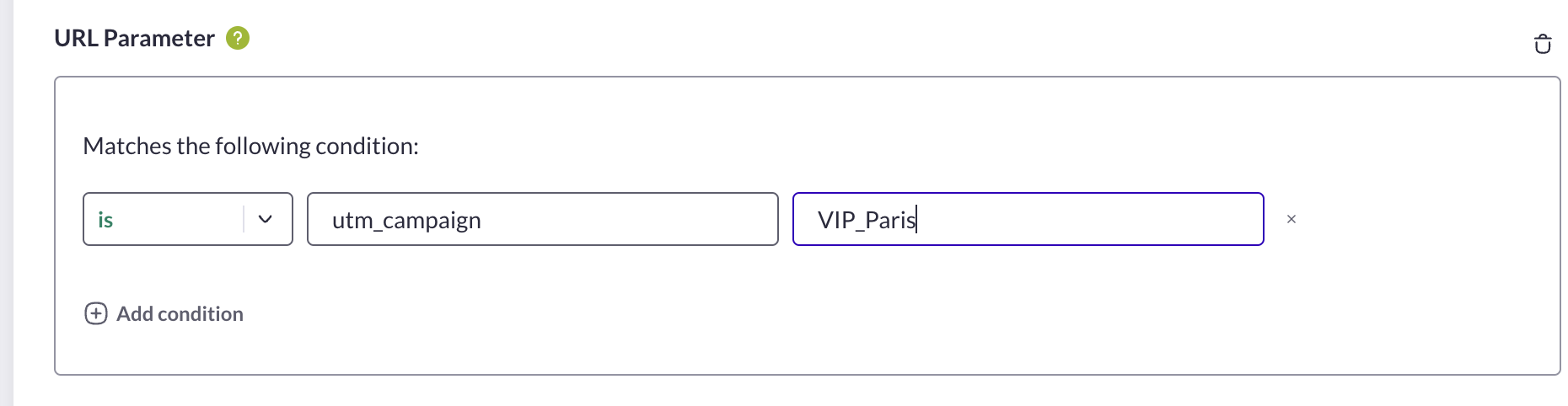
To configure the URL Parameter criterion, choose whether you want to include (`is`) or exclude (`is not`) a key (ex: utm\_source) and enter the value of this key if there is one (ex: google).
{% hint style="info" %}
For the name and value of the parameter, you need to enter the string without `?` and `=` characters. This triggering criterion only works with query parameters such as `?`. It doesn’t work with hash `#`).
{% endhint %}
## 💡 Use case
Let’s say you want to trigger your campaign on VIPs users that come from a specific newsletter you have sent your VIP clients.
These people have received an email with a specific key (for example *utm\_campaign*) and value (for example *VIPParis*) appearing in the URL of their webpage. To trigger your campaign for this traffic source only, in the URL parameter trigger, you need to specify the key and value related to this email. In this example, it will be `utm_campaign` and `VIP_Paris`.
## 🔎 How does it work?
The AB Tasty tag reads that information directly from the DOM `window.location.href` element.
**Need additional information?**
Submit your request at
Always happy to help!
---
# Agent Instructions
This documentation is published with GitBook. GitBook is the documentation platform designed so that both humans and AI agents can read, navigate, and reason over technical content effectively. Learn more at gitbook.com.
## Querying This Documentation
If you need additional information that is not directly available in this page, you can query the documentation dynamically by asking a question.
Perform an HTTP GET request on the current page URL with the `ask` query parameter, and the optional `goal` query parameter:
```
GET https://docs.abtasty.com/assets-library/creating-and-managing-triggers/list-of-trigger-criteria/url-parameter-criterion.md?ask=&goal=
```
`ask` is the immediate question: it should be specific, self-contained, and written in natural language.
`goal` is optional and describes the broader end goal you are ultimately trying to accomplish on behalf of the user. GitBook uses it to tailor the answer towards what is most useful for that goal.
The response will contain a direct answer to the question and relevant excerpts and sources from the documentation.
Use this mechanism when the answer is not explicitly present in the current page, you need clarification or additional context, or you want to retrieve related documentation sections.

 ## 🔎 How does it work?
The AB Tasty tag reads that information directly from the DOM `window.location.href` element.
**Need additional information?**
Submit your request at
## 🔎 How does it work?
The AB Tasty tag reads that information directly from the DOM `window.location.href` element.
**Need additional information?**
Submit your request at  ---
# Agent Instructions
This documentation is published with GitBook. GitBook is the documentation platform designed so that both humans and AI agents can read, navigate, and reason over technical content effectively. Learn more at gitbook.com.
## Querying This Documentation
If you need additional information that is not directly available in this page, you can query the documentation dynamically by asking a question.
Perform an HTTP GET request on the current page URL with the `ask` query parameter, and the optional `goal` query parameter:
```
GET https://docs.abtasty.com/assets-library/creating-and-managing-triggers/list-of-trigger-criteria/url-parameter-criterion.md?ask=
---
# Agent Instructions
This documentation is published with GitBook. GitBook is the documentation platform designed so that both humans and AI agents can read, navigate, and reason over technical content effectively. Learn more at gitbook.com.
## Querying This Documentation
If you need additional information that is not directly available in this page, you can query the documentation dynamically by asking a question.
Perform an HTTP GET request on the current page URL with the `ask` query parameter, and the optional `goal` query parameter:
```
GET https://docs.abtasty.com/assets-library/creating-and-managing-triggers/list-of-trigger-criteria/url-parameter-criterion.md?ask=