> For the complete documentation index, see [llms.txt](https://docs.abtasty.com/llms.txt). Markdown versions of documentation pages are available by appending `.md` to page URLs; this page is available as [Markdown](https://docs.abtasty.com/assets-library/creating-and-managing-segments/list-of-segment-criteria/csat-criterion-customer-satisfaction.md).
# CSAT criterion (Customer Satisfaction)
This article will show you how to use this Segment criterion.
CSAT is a segmentation criterion that enables defining a [segment](/assets-library/creating-and-managing-segments.md).
To learn how to create a segment, please refer to this [article](/web-experimentation-and-personalization/targeting-step/how-to-create-a-segment-who-section.md).
## Getting the best from your satisfaction monitoring
The [CSAT widget](/web-experimentation-and-personalization/editors-and-widget/list-of-widgets/ab-tasty-prebuilt-widgets/csat-widget.md) is a powerful tool to monitor the satisfaction of your visitors. You can use it for long term monitoring, getting feedback from a new webpage, a new service and so on.\
But you can also act on the visitors that rated their experience by creating segments based on their score then personalize their future visits on the website.
## ⚙️ Configuration
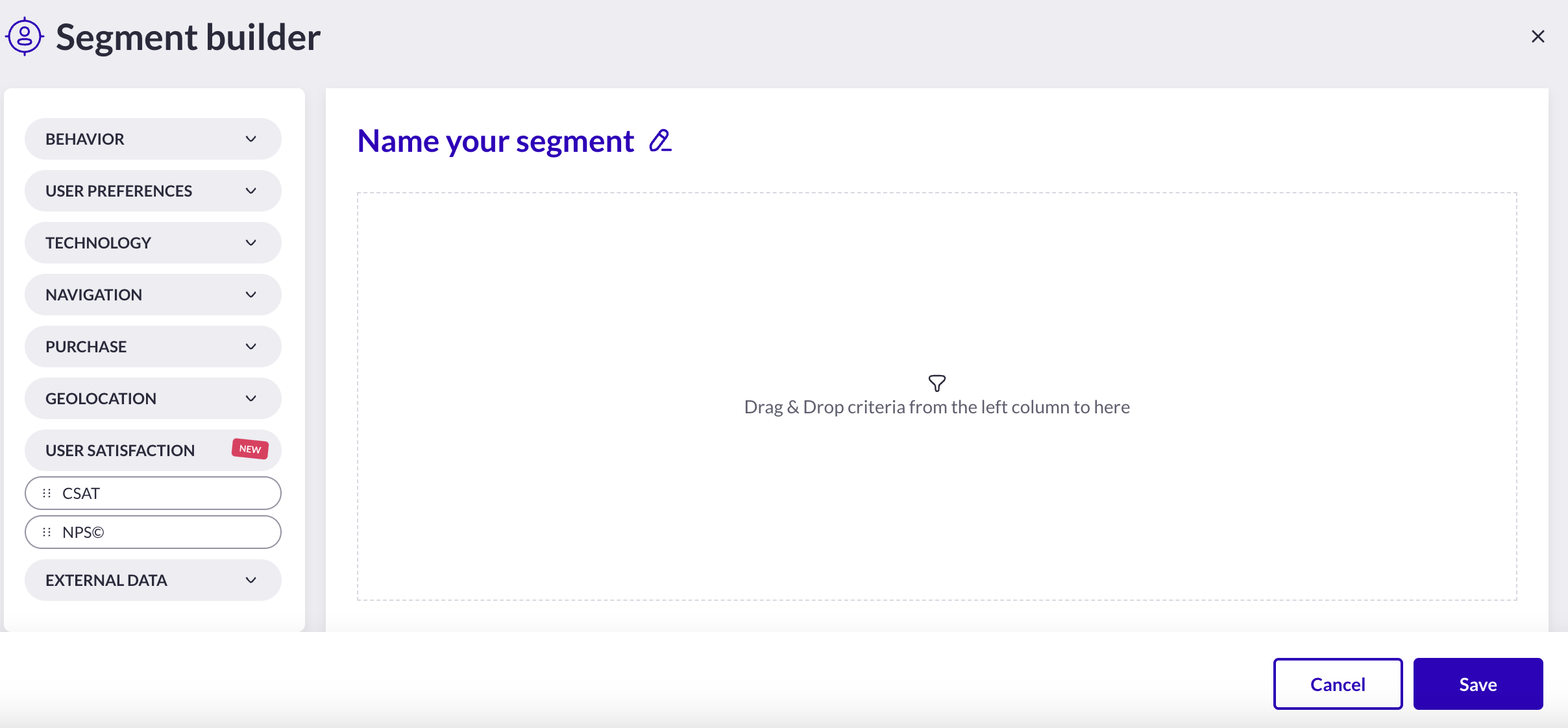
In the segment builder, under the ***User satisfaction*** category, you will find 2 criteria : CSAT and [NPS©](/assets-library/creating-and-managing-segments/list-of-segment-criteria/nps-criterion-customer-satisfaction.md).\
**Drag and drop** the CSAT criterion in the right panel and let's configure the form.
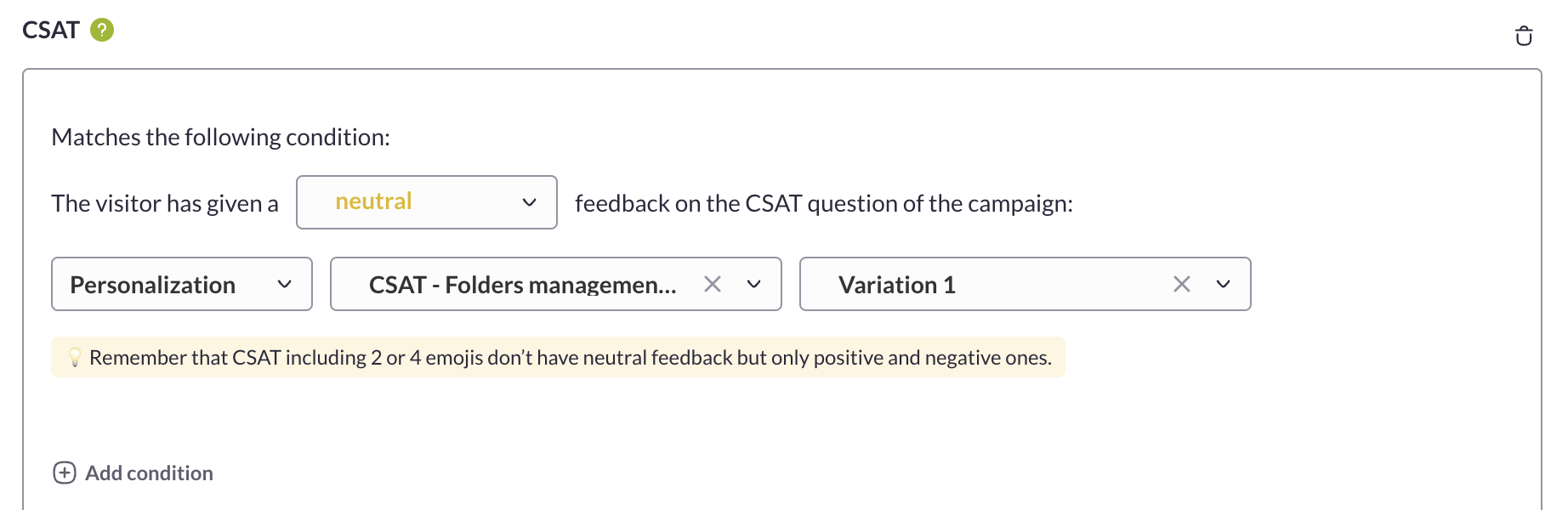
 The CSAT criterion allows you to target specific visitors that were previously exposed to a **previous CSAT campaign and left a response**.
1. **Target visitors according to the feedback they left** : *Positive* (5 or 4), *Neutral* (3), *Negative* (2 or 1), whatever the campaign was
2. **Specify the campaign type, the campaign name and the variation** where they submit the feedback (variation is optional).
The CSAT criterion allows you to target specific visitors that were previously exposed to a **previous CSAT campaign and left a response**.
1. **Target visitors according to the feedback they left** : *Positive* (5 or 4), *Neutral* (3), *Negative* (2 or 1), whatever the campaign was
2. **Specify the campaign type, the campaign name and the variation** where they submit the feedback (variation is optional).
 {% hint style="info" %}
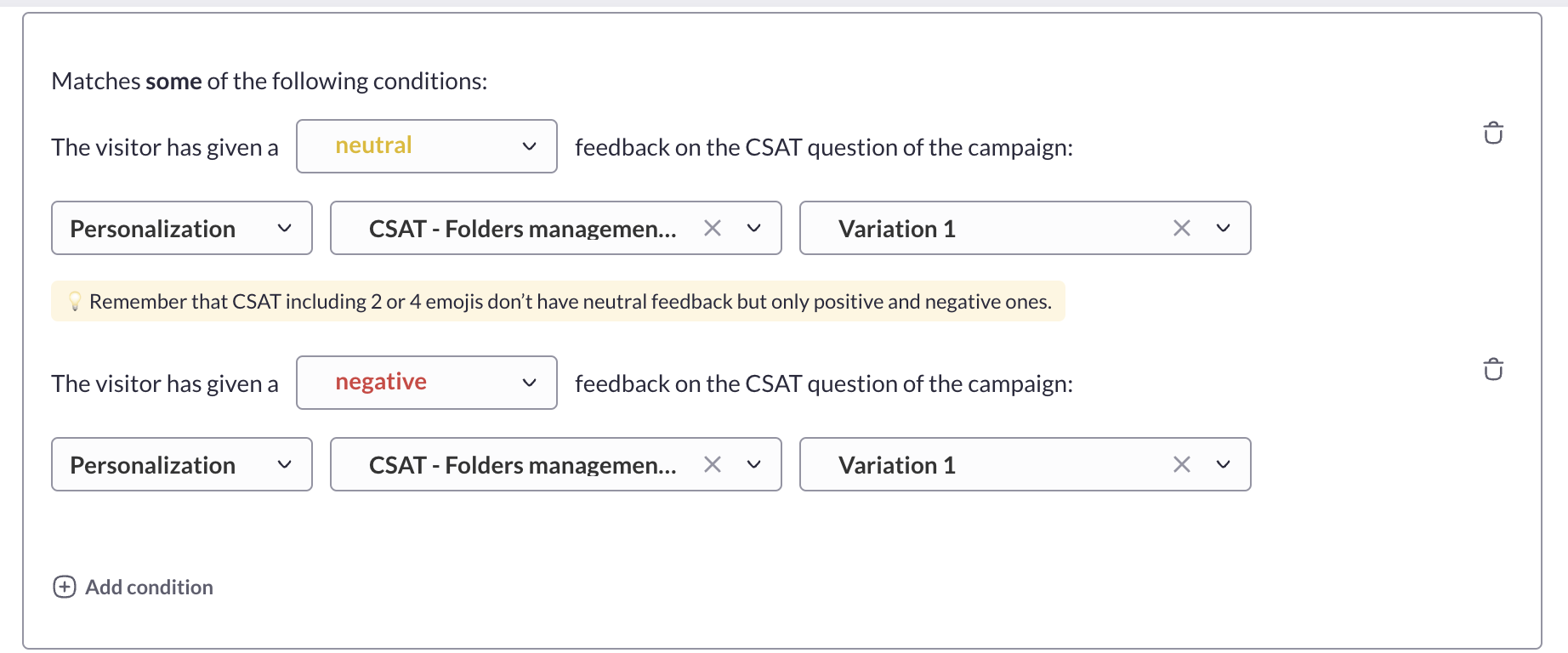
Note that you can select the ***‘+ add condition’***** option** if you want an additional condition from another campaign. In this case, the AB Tasty tag will check if one condition **OR** the other is met. This is an alternative verification :
{% endhint %}
{% hint style="info" %}
Note that you can select the ***‘+ add condition’***** option** if you want an additional condition from another campaign. In this case, the AB Tasty tag will check if one condition **OR** the other is met. This is an alternative verification :
{% endhint %}
 {% hint style="info" %}
Do not forget to name your segment properly and save it.
{% endhint %}
**For the QA**, the segment you have built will return as *‘true’* or *‘false’* in the console or as *‘accepted’* or *‘rejected’* in the [QA Assistant](/web-experimentation-and-personalization/qa-step/qa-mode--qa-assistant.md) as any other segment or trigger.
## 🔎 How does it work?
When a visitor gives a rate in a CSAT campaign, the information is stored in their **local storage**.\
So in order to segment your visitors according to CSAT, **a campaign should have run and collected ratings** (obvious so far) and the visitors should not have cleared their local storage.
{% hint style="info" %}
The scoring is erased and updated if a visitor responds differently to the same campaigns
{% endhint %}
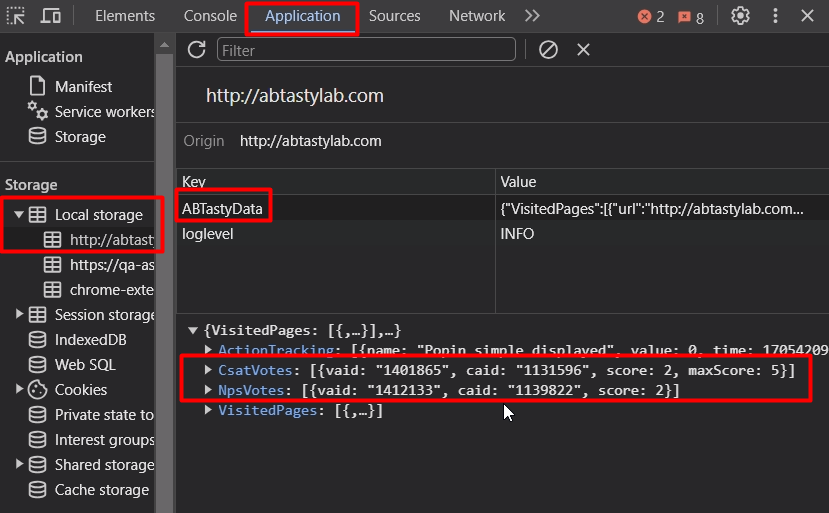
You can see the scores when inspecting your webpage :
`Application` > `Local storage` > `websitedomain` > `ABTastyData` > objects `CsatVotes` & `NpsVotes`
{% hint style="info" %}
Do not forget to name your segment properly and save it.
{% endhint %}
**For the QA**, the segment you have built will return as *‘true’* or *‘false’* in the console or as *‘accepted’* or *‘rejected’* in the [QA Assistant](/web-experimentation-and-personalization/qa-step/qa-mode--qa-assistant.md) as any other segment or trigger.
## 🔎 How does it work?
When a visitor gives a rate in a CSAT campaign, the information is stored in their **local storage**.\
So in order to segment your visitors according to CSAT, **a campaign should have run and collected ratings** (obvious so far) and the visitors should not have cleared their local storage.
{% hint style="info" %}
The scoring is erased and updated if a visitor responds differently to the same campaigns
{% endhint %}
You can see the scores when inspecting your webpage :
`Application` > `Local storage` > `websitedomain` > `ABTastyData` > objects `CsatVotes` & `NpsVotes`
 More information about CSAT widget in this [article](/web-experimentation-and-personalization/editors-and-widget/list-of-widgets/ab-tasty-prebuilt-widgets/csat-widget.md).
**Need additional information?**
Submit your request at
Always happy to help!
More information about CSAT widget in this [article](/web-experimentation-and-personalization/editors-and-widget/list-of-widgets/ab-tasty-prebuilt-widgets/csat-widget.md).
**Need additional information?**
Submit your request at
Always happy to help!
 ---
# Agent Instructions
This documentation is published with GitBook. GitBook is the documentation platform designed so that both humans and AI agents can read, navigate, and reason over technical content effectively. Learn more at gitbook.com.
## Querying This Documentation
If you need additional information that is not directly available in this page, you can query the documentation dynamically by asking a question.
Perform an HTTP GET request on the current page URL with the `ask` query parameter, and the optional `goal` query parameter:
```
GET https://docs.abtasty.com/assets-library/creating-and-managing-segments/list-of-segment-criteria/csat-criterion-customer-satisfaction.md?ask=&goal=
```
`ask` is the immediate question: it should be specific, self-contained, and written in natural language.
`goal` is optional and describes the broader end goal you are ultimately trying to accomplish on behalf of the user. GitBook uses it to tailor the answer towards what is most useful for that goal.
The response will contain a direct answer to the question and relevant excerpts and sources from the documentation.
Use this mechanism when the answer is not explicitly present in the current page, you need clarification or additional context, or you want to retrieve related documentation sections.
---
# Agent Instructions
This documentation is published with GitBook. GitBook is the documentation platform designed so that both humans and AI agents can read, navigate, and reason over technical content effectively. Learn more at gitbook.com.
## Querying This Documentation
If you need additional information that is not directly available in this page, you can query the documentation dynamically by asking a question.
Perform an HTTP GET request on the current page URL with the `ask` query parameter, and the optional `goal` query parameter:
```
GET https://docs.abtasty.com/assets-library/creating-and-managing-segments/list-of-segment-criteria/csat-criterion-customer-satisfaction.md?ask=&goal=
```
`ask` is the immediate question: it should be specific, self-contained, and written in natural language.
`goal` is optional and describes the broader end goal you are ultimately trying to accomplish on behalf of the user. GitBook uses it to tailor the answer towards what is most useful for that goal.
The response will contain a direct answer to the question and relevant excerpts and sources from the documentation.
Use this mechanism when the answer is not explicitly present in the current page, you need clarification or additional context, or you want to retrieve related documentation sections.